Today's Runes for Fidel Castro
| The Norn spread is used to plot the crucial elements of past, present, and future, and to reveal the evolution of the situation through the arc of time. Gold Runes are most commonly used for questions about business, career, and property. |
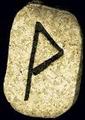
| The left rune represents an important element of the past. Wunjo is the rune of Joy. Since joy is least frequently a solitary emotion, this rune often represents mutual or communal bliss. Wunjo is also seen as a rune of the gods and a rune of perfection, carrying with it the elation that blazes from the creation of a perfect work - perhaps this is the true joy of the gods, that they can create perfection. That aside, this rune does not focus on the struggle for perfection or on our inevitable imperfections, but rather on a job well done and the satisfaction that comes from it. |
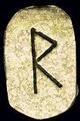
| The middle rune represents a deciding element of the present. Raido means to ride. In this rune, the image is not so much the riding of a horse as in riding in a cart or as cargo. As such Raido may suggest a journey, but is much more indicative of communication. Alternate interpretations based on the use of Raido as a cognate in other words give it the meaning of council, judgment, and moral correctness. Therefore, this rune is the rune of wise advice and good leadership. |
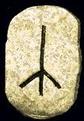
| The right rune represents the critical element of the future. Algiz plainly shows the antlers of the elk that it represents. The elk is the object of the hunt, and hence Algiz speaks to the pursuit of goals and the thrill of that pursuit. The rune is currently shown reversed, so this could suggest a failed endeavor or a lack of effort. Algiz is also representative of a protective hand (fingers open wide), so the reversed form may indicate a failed defense. |
|
|