Today's Runes for Leonardo da Vinci
| The Norn spread is used to plot the crucial elements of past, present, and future, and to reveal the evolution of the situation through the arc of time. Gold Runes are most commonly used for questions about business, career, and property. |
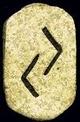
| The left rune represents an important element of the past. Ger is one of the runes that touches on the cycles of the year, in this case the fall harvest. These cycles are eternal, which is represented in the rune by the fact that it is unchanged by reversal. Ger can represent pregnancy or other forms of fruitfulness, and is especially indicative of the cycles of providence and karma - that which has been sown is now being reaped. This rune can also represent the cycles of wealth, for crops were frequently a sign of wealth. |
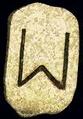
| The middle rune represents a deciding element of the present. Ehwaz is representative of the eight-legged horse ridden by the god Odin. As such, this is the rune of controlled movement and travel, including the pursuit of an objective or station in life. Since some older sources show Odin not as a man riding a horse but as a centaur-like being, this rune can also represent the union of man and nature, or the fusion of two entities in perfect harmony. As this rune is reversed, this could bode poorly for travel or for the vehicle involved. In the more spiritual sense, this rune could represent difficulties in self-improvement or other attempts at advancement. Finally, it may represent a splitting of two or the inability of two to act as one. |
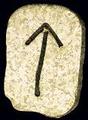
| The right rune represents the critical element of the future. Tyr is the symbol of the warrior. This rune most represents masculine force and potency, and frequently victory in battle. Beware though, for this rune represents directly the Norse god whose name it bears - Tyr stands out in legend for having sacrificed his hand that he might bind Fenrir, a monstrous wolf that threatens to swallow the world. As such, this rune is known to portend a great victory that can be bought with a terrible sacrifice. Tyr is also the god of law, frequently placed in such position above Odin. In this aspect, protection of justice may be had by this rune. |
|
|