Today's Tarot for Christopher Lee
| The Relationship spread provides insight into the interaction between two people or entities. It is the spread of choice for questions about partnerships, be they in romance or business. The Curious Tarot is the rarest and most unusual of modern decks. The cards form a surreal collage of American consumer imagery, eerily capturing the archetypes of the atomic age. It is the deck of those who seek to harness the ancient tribal energy that courses through the modern urban world. There are only 100 Curious Tarot decks in existence - if you want one, buy it now!
|
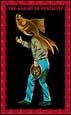
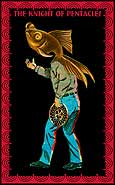 | The card at the top left represents how you see yourself. Knight of Pentacles: The essence of earth behaving as fire, such as molten magma: One slow to action, but decisive and unrelenting once set in motion. A force of nature whose methods are as predictable and dependable as they are unstoppable. The voice of duty, honor, and responsibility. The will to the change the world, not through bold action, but through the thorough and unwavering application of proven means. |
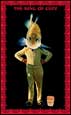
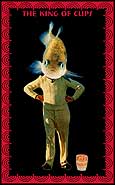 | The card at the top right represents how you see your partner. King of Cups: The essence of water behaving as air, such as a billowing cloud in the blue sky: Great maturity, endless patience, tolerance of other points of view, and a deep knowledge of human nature. One who intuitively knows the strengths of those around him, and gently cultivates them. Remaining calm and relaxed in all situations, and making artful use of diplomacy or a quiet word to resolve conflicts. The ability to listen to what another person is saying, and truly understand what is in their heart. A rewarding partner and a beloved leader. |
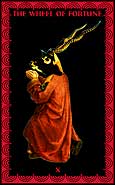 | The card in the center left represents how you feel about your partner. Wheel of Fortune: The path of destiny. Karma on a grand scale. An unexpected turn of good fortune. A link in the chain of events. Success, luck, and happiness. |
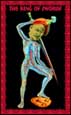
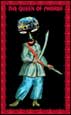
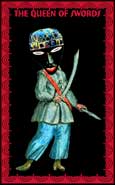 | The card in the center right represents what stands between you and your partner. Queen of Swords: The essence of air behaving as water, such as a refreshing mist: A person gifted with both keen logic and natural intuition, giving them uncanny powers of perception and insight. One who easily sees past deception and confusion to the heart of a matter, and understands both sides of any argument. The embodiment of calm, forthrightness, and wit, in the face of even the most trying circumstances. |
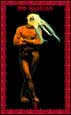
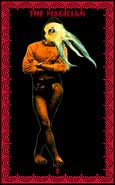 | The card in the lower left represents how your partner sees you. The Magician: Mastery over word, mind, and matter. The ability to turn ideas into actions, handle problems, and control one's life. The initiation of new projects, great works, or a new way of life. Eloquent and moving communication. Arcane and eldritch technologies. |
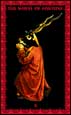
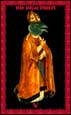
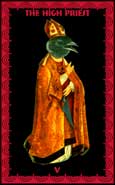 | The card in the lower right represents what your partner feels about you. The High Priest: Faith in tradition and the old school. A justified and ancient source of power. Being supportive, sympathetic and loyal. Receiving instructions, learning, guidance or inspiration. The ability to hear a higher or inner voice. May also indicate a religious ritual, such as a marriage or an initiation. |
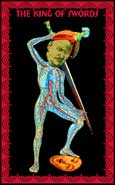 | The card in the center represents the present status or challenge of the relationship. King of Swords: The essence of air, such as a clear blue sky: A mature leader of unwavering ethics and indisputable authority. An incorruptible judge, whose devotion to the law cannot be swayed by emotion or material concerns. Perfect clarity of thought, directness of action, and eloquence of speech. One who, like a great general, inspires not love or devotion, but absolute trust and loyalty. |
|
|