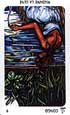
| The Celtic Cross spread is one of the most popular Tarot spreads, providing varied insight into many aspects of a complex situation and your role in it. The Voodoo Tarot of New Orleans is a deck rich in primal spirituality. It draws on images from the religion Santeria, which weaves Catholic and African beliefs into a vibrant tapestry. This exceptional deck is most often used to ask questions regarding the joy, fury, and spirituality in everyday life. If you would like your own copy of the Voodoo Tarot of New Orleans, you can buy it now! |
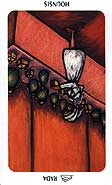 | The card not shown but at the center of the cross, represents the atmosphere surrounding the central issue. Rada Hounsis (Page of Swords), when reversed: The dark essence of air behaving as earth, such as a sandstorm: The approach of an unexpected challenge, met with muddled thought and unjust action. A person filled with a destructive appetite for all matters of mind and logic. Voyeurism, espionage, and misguided witch hunts. The use of clever argument and eloquent speech to mask the truth. |
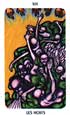
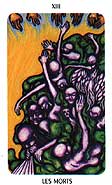 | The card visible at the center of the cross represents the obstacle that stands in your way - it may even be something that sounds good but is not actually to your benefit. Les Morts (Death): A major change or transformation, possibly traumatic and unexpected. Freedom from the shackles of the past. A new beginning. Death coupled with rebirth, usually related to consciousness and lifestyle. |
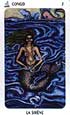
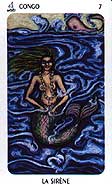 | The card at the top of the cross represents your goal, or the best you can achieve without a dramatic change of priorities. La Sirene (Seven of Cups): Daydreams and things seen in the glass of contemplation. The scattering of energies by strong desires and unrealistic goals. The pursuit of illusions and the dissipation of energy on false choices. Intoxication, delirium, and hallucination, leading to the negation of effort. Under rare and extreme circumstances, may indicate the revelation of transcendental spiritual truth. |
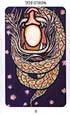
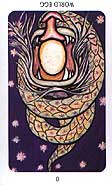 | The card at the bottom of the cross represents the foundation on which the situation is based. The World Egg (The Fool), when reversed: Apathy, negligence, and dangerous carelessness. Unquenchable wanderlust. Obsession with someone or something. Losing all sense of proportion. Foolhardy adventuring and lack of interest in critical matters. Immature or unrealistic ideals. Strange impulses and desires coming from unexpected sources. Vanity, delirium, folly, and oblivion. |
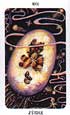
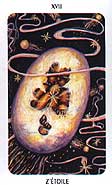 | The card at the left of the cross represents a passing influence or something to be released. Z'Etoile (The Star): New hopes and splendid revelations of the future. Insight, inspiration, courage and enlightenment of the spiritual self. Body and mind and converging towards the light at the end of a dark time. |
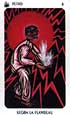
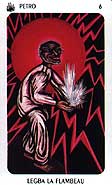 | The card at the right of the cross represents an approaching influence or something to be embraced. Legba La Flambeau (Six of Wands): A sense of honor and satisfaction at the resolution of an important matter. Triumph after great struggle. Jubilation at the hearing of good news. The realization of hopes and desires. |
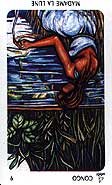 | The card at the base of the staff represents your role or attitude. Madame La Lune (Nine of Cups), when reversed: Vanity, conceit, and smugness in romance, friendship, or other relationships. Achieving what you always thought you wanted. Overindulging in food, drink, or the pleasures of the flesh. A state of joy and abundance that is shallow and fleeting. |
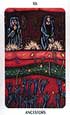
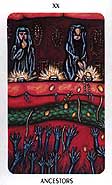 | The card second from the bottom of the staff represents your environment and the people you are interacting with. Ancestors (Judgment): A swift and conclusive decision. The resolution of a matter long unanswered. A change in point of view, most frequently towards greater enlightenment. Final balancing of karma. |
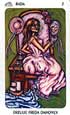
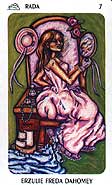 | The card second from the top of the staff represents your hopes, fears, or an unexpected element that will come into play. Erzulie Freda Dahomey (Seven of Swords): An opportunity to withdraw from a hopeless situation and fight another day. Disengagement from a struggle you should never have been involved in. A desperate attempt to resolve a matter without conflict. The use of cleverness or outright deception to turn the tide in your favor. |
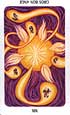
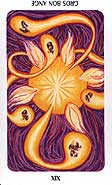 | The card at the top of the staff represents the ultimate outcome should you continue on this course. Gros Bon Ange (The Sun), when reversed: Loneliness and uncertainty. Nostalgic memories. The warm passing glow of dusk. Peace without vigilance. |