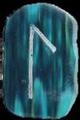
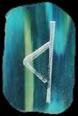
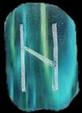
Today's Runes for Franz Kafka
| The Cross spread is used to plot the arc of your life and the forces acting on it. It is the most popular spread, giving a very complete view of the situation. Jade Runes are most commonly used for questions about love, friendship, and relationships. |
| The left rune represents an important element of the past. Wunjo is the rune of Joy. Since joy is least frequently a solitary emotion, this rune often represents mutual or communal bliss. Wunjo is also seen as a rune of the gods and a rune of perfection, carrying with it the elation that blazes from the creation of a perfect work - perhaps this is the true joy of the gods, that they can create perfection. That aside, this rune does not focus on the struggle for perfection or on our inevitable imperfections, but rather on a job well done and the satisfaction that comes from it. |
| The middle rune represents a deciding element of the present. Gebo means gift, and like any gifts, the rune may be understood on many levels. Gifts are generally positive things, for both the giver and the recipient. In many cultures however, gifts and favors carry with them an obligation to respond in kind. It is for this reason that gifts, and hence the rune Gebo, are frequently symbolic of friendships, marriages, alliances, mergers, and other bonds between people or organizations. Gebo is a strong rune and the unions represented are strong as well. Moreover, Gebo is not reversible, as true friendships are not easily undone. |
| The top rune represents a force that works for you. Algiz can be easily recognized as the antlers of the elk that it represents. The elk can represent victory, but is much more appropriately associated with the thrill of the hunt itself. This rune therefore can portend vigor and success in active endeavors. Also, this rune seems symbolic of a hand with outstretched fingers - a protective hand. This hand may suggest that you will be shielded from things negative - the problems still exist, you are spared the brunt of their force. |
| The bottom Rune represents a force that works against you. Tyr is the symbol of the warrior. This rune most represents masculine force and potency, and frequently victory in battle. Beware though, for this rune represents directly the Norse god whose name it bears - Tyr stands out in legend for having sacrificed his hand that he might bind Fenrir, a monstrous wolf that threatens to swallow the world. As such, this rune is known to portend a great victory that can be bought with a terrible sacrifice. Tyr is also the god of law, frequently placed in such position above Odin. In this aspect, protection of justice may be had by this rune. |
| The right rune represents the critical element of the future, at the core of the final outcome. Ger is one of the runes that touches on the cycles of the year, in this case the fall harvest. These cycles are eternal, which is represented in the rune by the fact that it is unchanged by reversal. Ger can represent pregnancy or other forms of fruitfulness, and is especially indicative of the cycles of providence and karma - that which has been sown is now being reaped. This rune can also represent the cycles of wealth, for crops were frequently a sign of wealth. |
|
|