Today's Runes for Frederick II
| The Cross spread is used to plot the arc of your life and the forces acting on it. It is the most popular spread, giving a very complete view of the situation. Ice Runes are most commonly used for questions about struggle, conflict, and achievement. |
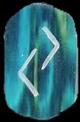
| The left rune represents an important element of the past. Dagez means daylight, and represents divine light. This rune generally refers to dawn (the initial sparking of energy) or to midday (the climax of energy). Both dawn and midday are symbolic of change, but unlike the changes in the perpetual circle of the year which are slow and subtle, the changes over a day are much faster and more dramatic. The breaking of a new day is symbolic of the rapid illumination of dismal circumstances, and is suggestive of Satori. Be careful - although this rune generally suggests a positive change, the symbology of a peaking point suggests that there must be a change downward as well. Fortunately for some, this rune is cyclic and irreversible, and so permanence is not promised - the only thing you can be sure of is an exciting ride. |
| The middle rune represents a deciding element of the present. Tyr is the symbol of the warrior. This rune most represents masculine force and potency, and frequently victory in battle. Beware though, for this rune represents directly the Norse god whose name it bears - Tyr stands out in legend for having sacrificed his hand that he might bind Fenrir, a monstrous wolf that threatens to swallow the world. As such, this rune is known to portend a great victory that can be bought with a terrible sacrifice. Tyr is also the god of law, frequently placed in such position above Odin. In this aspect, protection of justice may be had by this rune. |
| The top rune represents a force that works for you. Fehu is the rune of cattle, the symbol of wealth in the old Norse civilization. Since Fehu is the first rune in Frey's aett, it is a rune of fertility as well. As seen here reversed, it can represent barrenness or the loss of wealth. Some interpret Fehu as representing children, in which case the reversal may portend the distancing of a child from her or his parents. |
| The bottom Rune represents a force that works against you. Ehwaz is representative of the eight-legged horse ridden by the god Odin. As such, this is the rune of controlled movement and travel, including the pursuit of an objective or station in life. Since some older sources show Odin not as a man riding a horse but as a centaur-like being, this rune can also represent the union of man and nature, or the fusion of two entities in perfect harmony. As this rune is reversed, this could bode poorly for travel or for the vehicle involved. In the more spiritual sense, this rune could represent difficulties in self-improvement or other attempts at advancement. Finally, it may represent a splitting of two or the inability of two to act as one. |
| The right rune represents the critical element of the future, at the core of the final outcome. Laguz is the most strongly feminine of runes, representing water. Deep sexuality is suggested by this rune. Through Laguz, water is seen as the ocean - vast, uncontrollable, ever-changing, and vital. When interpreted as the returning tide, Laguz can also predict the inevitable return from a long journey. |
|
|