Today's Runes for Henry Ford
| The Cross spread is used to plot the arc of your life and the forces acting on it. It is the most popular spread, giving a very complete view of the situation. Stone Runes are most commonly used for questions about the natural world and things beyond human control. |
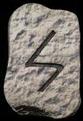
| The left rune represents an important element of the past. Sowelu is a strong symbol, for it represents the sun. Unlike equatorial cultures who may see the sun as a harsh and imperial force capable of causing droughts, in the cold north the sun is a purely feminine force that gives life and allows crops to grow. In dark times, this rune represents clarity of sight and the victory of good over evil. Sowelu is irreversible, as the cycles of the sun and seasons are perpetual. |
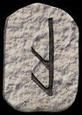
| The middle rune represents a deciding element of the present. Ansuz is the spoken word of God. This rune is reversed, indicating that you are misunderstanding the divine voice or failing to hear it all. The word is always correct, so you must strive, whatever the difficulty, to hear correctly. Be wary of the advice you are given, for it may prove incorrect. Do not attribute infallibility to fallible sources... |
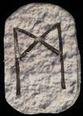
| The top rune represents a force that works for you. Man represents Mankind. This rune evokes the image that although we must make much of our way in the world on our own, there is nevertheless an entire populous that shares similar experiences. Thus, this rune represents the relationship of the self with the whole - working together we can produce great results. Additionally, Man speaks to intellect and culture that separate us from the animals. |
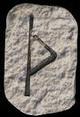
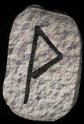
| The bottom Rune represents a force that works against you. Wunjo is the rune of Joy. Since joy is least frequently a solitary emotion, this rune often represents mutual or communal bliss. Wunjo is also seen as a rune of the gods and a rune of perfection, carrying with it the elation that blazes from the creation of a perfect work - perhaps this is the true joy of the gods, that they can create perfection. That aside, this rune does not focus on the struggle for perfection or on our inevitable imperfections, but rather on a job well done and the satisfaction that comes from it. |
| The right rune represents the critical element of the future, at the core of the final outcome. Thurisaz represents a thorn, the most basic of barriers to our boon or our bane. In the case of hedges, thorns protect our encampments from that which skulks towards us from the outlands. In the case of rosebushes, thorns keep us from beauty. Though thorns are passive and have no thoughts, they puncture, tear, and may even be poisonous. Hence, this rune may also represent irrational violence and anger. |
|
|