Today's Runes for Robert A. Heinlein
| The Diamond spread reveals the dynamic forces at work in a situation. It is the spread of choice for understanding a hidden conflict. Gold Runes are most commonly used for questions about business, career, and property. |
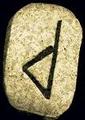
| The bottom rune represents the foundation that forms the basis of the issue. Wunjo is the rune of joy. The reversal of this rune suggests that joy is withheld. Since joy is frequently communal, this rune often suggests loneliness. Alternatively, some have seen Wunjo as the rune of perfection and the rune of the gods. Therefore this rune reversed could signal a feeling of separation from one's deity, or as imperfection in an important work. |
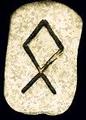
| The left rune represents one of the forces acting on the issue at hand. Othila is the homeland. Land was the purest form of immovable wealth in Norse civilization, distinct from the movable wealth represented by Fehu. This rune speaks of stability and safety stemming from inheritance, both material and genetic. With respect to the question asked, consider the background of the people and families involved... |
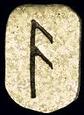
| The right rune represents another of the forces acting on the issue at hand. Ansuz refers to a god or the spoken word of God. It is the voice of reason, law, prophecy and truth. It is the truth heard in the wind. This rune represents wisdom obtained or knowledge delivered. It is the rune of absolute good advice and true council - the message we all must strive to hear. |
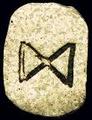
| The top rune represents the conclusion to which your strivings can carry you. Dagez means daylight, and represents divine light. This rune generally refers to dawn (the initial sparking of energy) or to midday (the climax of energy). Both dawn and midday are symbolic of change, but unlike the changes in the perpetual circle of the year which are slow and subtle, the changes over a day are much faster and more dramatic. The breaking of a new day is symbolic of the rapid illumination of dismal circumstances, and is suggestive of Satori. Be careful - although this rune generally suggests a positive change, the symbology of a peaking point suggests that there must be a change downward as well. Fortunately for some, this rune is cyclic and irreversible, and so permanence is not promised - the only thing you can be sure of is an exciting ride. |
|
|