Today's Runes for The Rock
| The Fork spread is used at critical turning points, to understand the dynamics of an important decision. Spirit Runes are most commonly used for questions about mysticism, spirituality, and religion. |
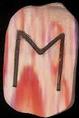
| The left rune represents the first possible outcome. Ehwaz is the rune of the eight-legged horse that the god Odin rode into battle. Horses are symbolic of a number of things. Firstly, horses may symbolize vehicles such as cars, motorcycles, planes, or boats. Secondly, horses may symbolize not wealth, but status. Thirdly, horses may symbolize motion towards an objective. As such, this rune suggests a journey or a quest to achieve a goal or improve one's station in life. On a deeper level, the rune Ehwaz evokes the unique relationship of horse and rider as an inseparable team. To the modern eye this may be the relationship of master and underling, but to the Norse it was a total union. In fact, early representations of Odin are not of a man and a horse, but, of a centaur-like creature - the ultimate symbiosis of Man and Nature. |
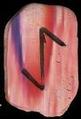
| The right rune represents the second possible outcome. Eoh refers to the Yew tree. The Yew does not go dormant and therefore represents endurance. Even the wood of the tree is strong, resilient, and pliable - the Yew bends, but does not break. The evergreen nature of the Yew is present even in the rune itself, as it cannot be changed even by reversal. This rune is historically symbolic of death, but, as in the Tarot and as suggested by the nature of the Yew tree itself, death is seen only as a transmutation of something eternal and unchanging - the spirit. |
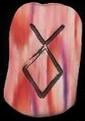
| The bottom rune represents the critical factor that determines what will come to pass. Othila is the homeland. Unlike Fehu, this is the rune of immovable wealth. On a deeper level, this rune speaks to that which you inherit, be it material or genetic. Since Othila is seen reversed here, the obstacles you confront are among those things in your background that you take for granted and consider fairly stable. Problems from the "homeland", from familial inheritance, or from our own origins may be worked around, but they cannot be made to go away. Fortunately, for many problems, this is all that is required. |
|
|