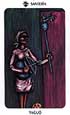
Today's Tarot for Avril Lavigne
| The Cross and Triangle spread is a powerful means of understanding complex situations, developed by the Hermetic Order of the Golden Dawn. This spread is rich in occult and mystical symbolism, and one of our favorites here at Facade. The Voodoo Tarot of New Orleans is a deck rich in primal spirituality. It draws on images from the religion Santeria, which weaves Catholic and African beliefs into a vibrant tapestry. This exceptional deck is most often used to ask questions regarding the joy, fury, and spirituality in everyday life. If you would like your own copy of the Voodoo Tarot of New Orleans, you can buy it now! |
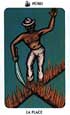
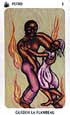
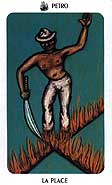 | The first card, the significator, is placed in the center of the cross. This card represents the prime energy manifest in your life. Petro La Place (Knight of Wands): The essence of fire, such a great conflagration. One filled with vitality and passion for life. A sexy and exciting person, daring in their actions, cocky in their attitude, and utterly without fear. Absolute sincerity, coupled with violent emotions that swing wildly from one extreme to another. Boundless creativity and lust for a change of both pace and place. The rapid approach, or more likely departure, of something that sets your world ablaze. Often suggests travel or escape. |
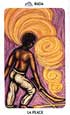
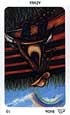
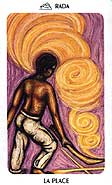 | The second card, placed above the significator, represents Air. It describes your spirit, process of thought, and the influence of reason. Rada La Place (Knight of Swords): The essence of air behaving as fire, such as a tornado: A fearless and skillful warrior, unfettered by emotion or material concerns. One able to boldly take on challenges that others consider terrifying or insurmountable. A person who inspires fear and awe through the purity of their purpose and the intensity of their intellect. Speaking frankly, in an outspoken manner, and with great influence. May portend the swift initiation or conclusion of a conflict, through the decisive invocation of force. |
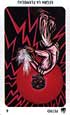
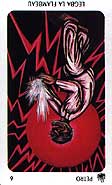 | The third card, placed to the right of the significator, represents Fire. It describes your motivations, creative energies, and the influence of passion. Legba La Flambeau (Six of Wands), when reversed: Arrogance and dangerous overconfidence as the result of a past success. Impudence and false pride in meaningless achievements. Fear of failure coupled with false hopes. Frustration over indefinite delays and motion without progress. |
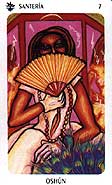 | The fourth card, placed below the significator, represents Water. It describes your emotions, meditations, and the influence of love. Oshun (Seven of Discs): A pause to check on the progress of your labors. Making difficult financial decisions. Exercising patience and perseverance. Evaluating the status of your work and your options for the future. |
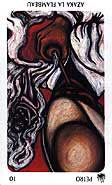 | The fifth card, placed to the left of the significator represents Earth. It describes your physical presence, position in life, and the influence of the material world. Azaka La Flambeau (Ten of Wands), when reversed: Refusing to take on burdens greater than you can carry. Noble leadership restrained from transforming into tyranny. Bearing the weight of ultimate responsibility without being crushed. Through careful conservation of their fuel, the engines of creation continue onward. |
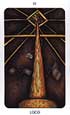
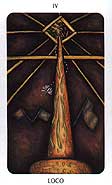 | At this point the cross is complete and the triangle is formed. The sixth card, placed on the bottom left of the triangle represents one of two opposing forces. Loco (The Emperor): Worldly authority and power. Social mastery and oratory. One who is intelligent, experienced, confident and reasonable. A patriarch or primary male influence. The motive force of politics and society. The ability to fulfill plans and use mental control over the emotions. |
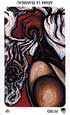
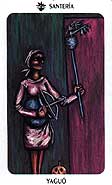 | The seventh card, placed on the bottom right of the triangle represents the force that opposes the bottom left card. These forces may be external, but they are frequently one's own inner archetypes in conflict. Yaguo (Page of Discs): The essence of earth, such as a mountain: The surprising appearance of new prosperity and opportunities for advance in the physical world. One who delights in the pleasures of the body, material things, and nature. The embrace of hard work, realistic goals, and scholarly perseverance as a means to create solid achievement. Dependability, trust, and a studious nature. May portend a new job or promotion. |
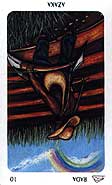 | The eighth card, the reconciler, is placed below the cross in the third vertex of the triangle. This is the force that will resolve the conflict between the bottom left and bottom right cards. By meditating on this force and bringing more of it into your life, you can bring the matter at hand to a swifter conclusion than would naturally occur. Azaka (Ten of Swords), when reversed: The darkness before the dawn. An end to suffering, leading to spiritual transformation. A crushing and seemingly total defeat that hides within it the seeds of final victory. Ultimate knowledge gained through ultimate sacrifice. |
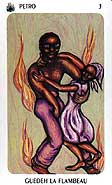 | The ninth and final card, placed in the center bottom of the triangle, represents the final outcome unless you change course. Guedeh La Flambeau (Three of Wands): Personal fortitude and strength of character. Accumulated power set in motion towards a distant goal. The initiation of an enduring partnership based on absolute trust. Honor maintained in a time of desperate struggle. Taking full responsibility for a decision, and bearing the solitude of leadership. |
|
|