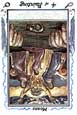
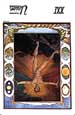
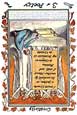
| The Celtic Cross spread is one of the most popular Tarot spreads, providing varied insight into many aspects of a complex situation and your role in it. The William Blake Tarot explores the mystical vision and artistry of the renowned English painter and poet. Through rich interpretations focused on creative undertakings, it has long been the deck of choice for artists, writers, musicians, and thinkers. For more information about this deck, or to buy your own personal copy, go to www.blaketarot.com.
|
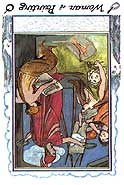 | The card not shown but at the center of the cross, represents the atmosphere surrounding the central issue. Woman of Painting, when reversed: Bureaucracy and administration to the exclusion of the creative. The pursuit of tangible rewards at all costs. Team building and cooperative efforts where a single vision is required. Supporting and acknowledging others for political gain. Infatuation with the shallow. In the creative process: Your creative ideas are now taking tangible form, assisted by good use of your available resources and personnel. |
 | The card visible at the center of the cross represents the obstacle that stands in your way - it may even be something that sounds good but is not actually to your benefit. Moon: Psychic insights. Relying on your instincts. Using your dreams and musings as sources of inspiration. Hidden conditions and unknown circumstances. Cyclic patterns and influences. |
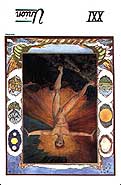 | The card at the top of the cross represents your goal, or the best you can achieve without a dramatic change of priorities. Union, when reversed: Something vitally important to you refuses to come together. Discord between male and female forces, or inner and outer life. Holding back. Incompleteness. Fear of intimacy or self-sacrifice. |
 | The card at the bottom of the cross represents the foundation on which the situation is based. Eternity, when reversed: The intervention of transcendent forces in the everyday world. The great are brought low and the petty are elevated. Obsession with the passage of time and the immanence of death. Being overwhelmed by the repetition of evil and mediocrity, and withdrawing from the world. Cynicism and nihilism driven by regret over past mistakes. |
 | The card at the left of the cross represents a passing influence or something to be released. Ace of Science (Intellect): Delving into the depths of knowledge. Focusing on multiple aspects of the job at hand. Development and use of multiple skills. Genesis of a great new idea. Analytical search for knowledge as truth. Using logic, method, and research to solve a problem. In the creative process: A time for "blind" absorption of data, for intense focus on research and documentation of the creative project being initiated. |
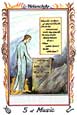
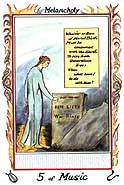 | The card at the right of the cross represents an approaching influence or something to be embraced. Five of Music (Melancholy): "Whatever is Born of Mortal Birth / Must be consumed with the Earth / To rise from Generation free: / Then what have I to do with thee?". Emotional disappointment. Existential angst. Spiritual insights following a sad event. Separating and moving on. Sadness, loss, grieving. Acknowledging your mistakes. Releasing ties and attachments from the past. In the creative process: Convert the pain of disappointment or loss into artistic expression. Let go of something old or dead and move on to something new and alive. |
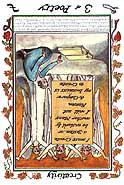 | The card at the base of the staff represents your role or attitude. Three of Poetry (Creativity), when reversed: Seeking a creative opportunity in a commercial environment. Imaginative approaches are squandered in mundane circumstances. Seeking Truth where only Fact can be found. In the creative process: You get the go-ahead to "do your thing"; your project has special blessing at this time because of your ability to see an overview or get the big picture. |
 | The card second from the bottom of the staff represents your environment and the people you are interacting with. Eight of Music (Discontent), when reversed: Freedom from disappointment and dissatisfaction. The release of repressed emotions and distress. Being unphased by circumstances. Emotional stability in the face of challenge. Serenity. In the creative process: Psychodrama and emotional torments can serve as imaginative stimulants. Expressing and documenting what you feel can be artful as well as healing. |
 | The card second from the top of the staff represents your hopes, fears, or an unexpected element that will come into play. Child of Music: "Piping down the valleys wild / Piping songs of pleasant glee". A need to kindle your emotions. Getting in touch with your own feelings. Willingness to take emotional risks. Marching to a personal rhythm. Taking risks for love. Experimenting with genuine self-expression. Empathy with others, and with animals. In the creative process: Go inside yourself to experience emotional innocence and primal voice. Don't be afraid to improvise in your own way. |
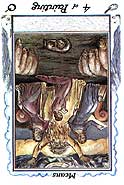 | The card at the top of the staff represents the ultimate outcome should you continue on this course. Four of Painting (Means), when reversed: Obsession with material prosperity and contentment. Attachment to money and material goods. Creative achievements blocked by lack of material resources. Consolidation of personnel and materials at the expense of the objective at hand. Overwhelming need for order and structure. Emphasis on controlling, dominating, or monopolizing. In the creative process: Before reaching out for creative inspiration, prepare the groundwork: by appropriately allocating your resources and assigning creative tasks. |