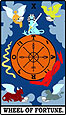
| The Twisting Path spread provides insight into the path ahead of you and the choices you must make. This is the spread for situations where more than one pitfall may lie ahead. The International Icon Tarot renders traditional occult symbolism in Swiss iconography. It is a humorous and direct approach to divination, and one of our favorite new decks. If you would like your own copy of the International Icon Tarot, you can buy it now!
|
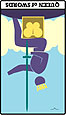
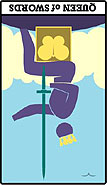 | The card at the lower left, represents the first decision along your path. Queen of Swords, when reversed: The dark essence of air behaving as water, such as a cold rain: A person gifted with both keen logic and natural intuition, giving them uncanny powers of perception and insight. One who easily sees the weakness in any argument, and savages friend and foe alike with biting sarcasm. Dry and vicious wit covering a hollow sense of isolation and dissatisfaction with life. |
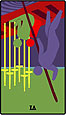
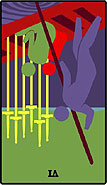 | The card to the far left represents the first false path that may lead you astray. Six of Swords (Science), when reversed: Conceit and intellectual pride. Being stuck in a problem which has no apparent solution. Frustration and anxiety that are left unsettled. Travel and exploration are delayed. |
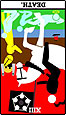
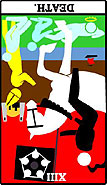 | The card in the middle represents the second decision along your path. Death, when reversed: Stagnation or petrifaction. The refusal to let go of the past. Resistance to change because of fear. |
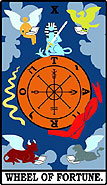 | The card at the lower right represents the second false path that may lead you astray. Wheel of Fortune: The path of destiny. Karma on a grand scale. An unexpected turn of good fortune. A link in the chain of events. Success, luck, and happiness. |
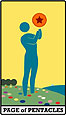
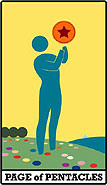 | The card at the top represents one possible mask of your true destination. Page of Pentacles: The essence of earth, such as a mountain: The surprising appearance of new prosperity and opportunities for advance in the physical world. One who delights in the pleasures of the body, material things, and nature. The embrace of hard work, realistic goals, and scholarly perseverance as a means to create solid achievement. Dependability, trust, and a studious nature. May portend a new job or promotion. |