Today's Tarot for Carmen Electra
| The Cross and Triangle spread is a powerful means of understanding complex situations, developed by the Hermetic Order of the Golden Dawn. This spread is rich in occult and mystical symbolism, and one of our favorites here at Facade. The Renaissance Tarot is a modern deck, with symbolism drawn from the heroic age and rendered in renaissance style. This deck is an excellent choice for exploring questions of passion, mastery, and the inner workings of human reason. If you would like your own copy of the Renaissance Tarot, you can buy it now! |
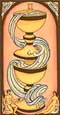
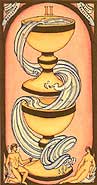 | The first card, the significator, is placed in the center of the cross. This card represents the prime energy manifest in your life. Two of Cups (Love): The flower of first love, of love at first sight. The bond between two people, invisible but formidable. |
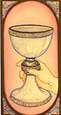
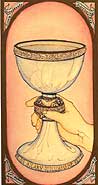 | The second card, placed above the significator, represents Air. It describes your spirit, process of thought, and the influence of reason. Ace of Cups: The free reign of the heart in overflowing joy and abundant love. |
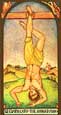
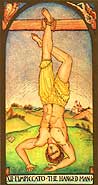 | The third card, placed to the right of the significator, represents Fire. It describes your motivations, creative energies, and the influence of passion. The Hanged Man: Sacrifice. Vigilance. Martyrlike forbearance. Suspension or paralysis of the soul. A mind divided and undecided. Stasis and constraint. |
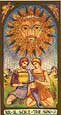
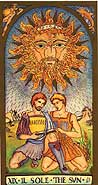 | The fourth card, placed below the significator, represents Water. It describes your emotions, meditations, and the influence of love. The Sun: Glory and rejoicing. The light of reason. The flower of manhood. Inspiration in poetry and music. |
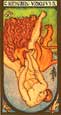
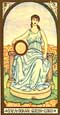
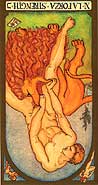 | The fifth card, placed to the left of the significator represents Earth. It describes your physical presence, position in life, and the influence of the material world. Strength, when reversed: Weakness. Unresolved conflict. |
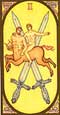
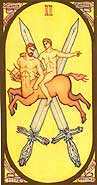 | At this point the cross is complete and the triangle is formed. The sixth card, placed on the bottom left of the triangle represents one of two opposing forces. Two of Swords (Peace): Friendship, especially between student and teacher or younger and older. The adventure and excitement of childhood and adolescence. |
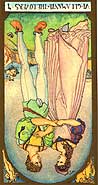 | The seventh card, placed on the bottom right of the triangle represents the force that opposes the bottom left card. These forces may be external, but they are frequently one's own inner archetypes in conflict. The Lovers, when reversed: Love unrequited, star-crossed, soured, illicit, blind or foolish. |
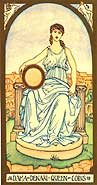 | The eighth card, the reconciler, is placed below the cross in the third vertex of the triangle. This is the force that will resolve the conflict between the bottom left and bottom right cards. By meditating on this force and bringing more of it into your life, you can bring the matter at hand to a swifter conclusion than would naturally occur. Queen of Coins: A person who embodies richness and fertility, generous, opulent, gracious and noble. A cornucopia of delights. A rock of security. A brilliant crystal of insight. A rich field for new growth. |
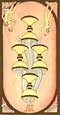
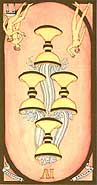 | The ninth and final card, placed in the center bottom of the triangle, represents the final outcome unless you change course. Four of Cups (Luxury), when reversed: New faith. New hope. A return to trust. |
|
|