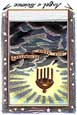
| The Celtic Cross spread is one of the most popular Tarot spreads, providing varied insight into many aspects of a complex situation and your role in it. The William Blake Tarot explores the mystical vision and artistry of the renowned English painter and poet. Through rich interpretations focused on creative undertakings, it has long been the deck of choice for artists, writers, musicians, and thinkers. For more information about this deck, or to buy your own personal copy, go to www.blaketarot.com.
|
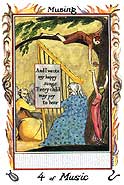 | The card not shown but at the center of the cross, represents the atmosphere surrounding the central issue. Four of Music (Musing): "And I wrote my happy songs / Every child may joy to hear". Being at peace with yourself. Taking the time to reminisce and let your mind wander. Relief from emotional stress. Combining business with pleasure. Focus on playful communication. Mulling things over. Relaxed and slow pace. In the creative process: Relax into playfulness, whimsically experiment with improvisation or reminiscence about past experiences. Such meditations alleviate stress and refresh the imagination. Make space for the gifts of spirit to move through you. |
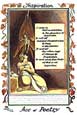
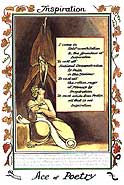 | The card visible at the center of the cross represents the obstacle that stands in your way - it may even be something that sounds good but is not actually to your benefit. Ace of Poetry (Inspiration): "I come in Self-annihilation & the grandeur of Inspiration / To cast of Rational Demonstration by Faith in the Saviour / To cast off the rotten rags of Memory by Inspiration / To cast aside from Poetry all that is not Inspiration". The kiss of divine inspiration. Receiving an impetus to creative action. Getting in touch with higher consciousness or Spirit. Experiencing a personal vision of truth, beauty, ecstasy. Discovering sexuality as a metaphor for imaginative experience. Sense of being guided by a higher force. The "Yes!" card. A soulful new beginning. In the creative process: Being in contact with the purest and highest part of your being provides the impetus for fresh expressions in both art and life. |
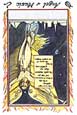
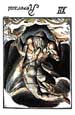
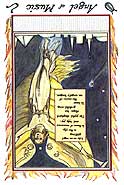 | The card at the top of the cross represents your goal, or the best you can achieve without a dramatic change of priorities. Angel of Music, when reversed: Restrained surge of passionate emotion. Lack of compassion. Inability to rise above a mundane or materialistic milieu. An unexpected lack of emotion. Withheld personal transformation. Undeveloped aesthetic sensibility. Misunderstanding of public needs or the mass media. In the creative process: An inrush of excitement or appearance of a new factor offers alternative possibilities for your work. |
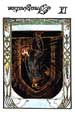
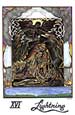
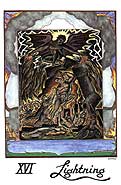 | The card at the bottom of the cross represents the foundation on which the situation is based. Lightning: An unexpected shock, upheaval, or stunning event. A burst of insight, or spiritual breakthrough. A close call. Release or liberation of energy. |
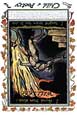
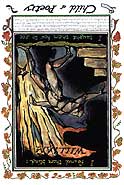 | The card at the left of the cross represents a passing influence or something to be released. Child of Poetry, when reversed: Lack of artistic discipline. Refusal to introspect or learn from the mistakes of others. Taking unnecessary risks. Bending over backwards in your effort to see the appropriate direction for self-development and creativity. In the creative process: An inspirational breakthrough is at your feet; it is up to your to pick up the energy and make the most of it. |
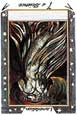
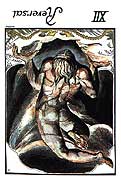 | The card at the right of the cross represents an approaching influence or something to be embraced. Reversal, when reversed: Inability to look at the situation in a new way or from a different perspective. Flailing about and getting lost in the search for solutions. Undue reliance on the unconventional. Inability to accept losses or reversals. Unwillingness to withstand a difficult or uncomfortable position. |
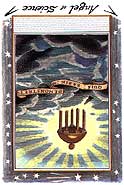 | The card at the base of the staff represents your role or attitude. Angel of Science, when reversed: Lost in the realm of pure or abstract thought. Cold, emotionless, and analytical thinking. Idle speculation. Lofty, possibly unreachable, goals. Scientific, intellectual, or "ivory tower" idealism. In the creative process: An intellectual vision or perfect insight inspires you to rise above yourself. |
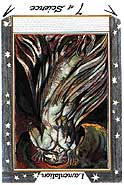 | The card second from the bottom of the staff represents your environment and the people you are interacting with. Seven of Science (Lamentation), when reversed: A great deal of psychic energy being unleashed. Strong resistance to pressure. Gathering, shaping, and polishing your ideas. In the creative process: When you are feeling stuck or blocked, push your imagination to find a way around the problem; rely on your energy and hard work. |
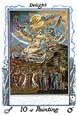
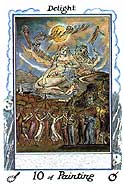 | The card second from the top of the staff represents your hopes, fears, or an unexpected element that will come into play. Ten of Painting (Delight): Your work or ideal takes on a life of it own. Financial prosperity. Achievement or promotion on the job. Inheriting something of tangible or permanent value. Family gatherings and traditions. Finding your roots. Active involvement in community and societal spheres. In the creative process: The success of completion of your project is cause for celebration and an opportunity to honor all the gods and spirits that participated in your benefit. |
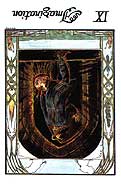 | The card at the top of the staff represents the ultimate outcome should you continue on this course. Imagination, when reversed: Failure to use wisdom and prudence. Too much reliance on novel solutions to conventional problems. Unwillingness to look within and seek an inspired resolution. |