Today's Tarot for Madonna
| The Cross and Triangle spread is a powerful means of understanding complex situations, developed by the Hermetic Order of the Golden Dawn. This spread is rich in occult and mystical symbolism, and one of our favorites here at Facade. The Rider Waite Tarot is the most widely recognized Tarot deck, and the first deck published in the 20th century. It was created by members of the Hermetic Order of the Golden Dawn, and is especially suited to questions of a mystical nature. If you would like your own copy of the Rider Waite Tarot, you can buy it now! |
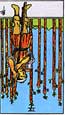
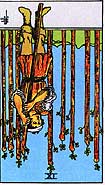 | The first card, the significator, is placed in the center of the cross. This card represents the prime energy manifest in your life. Nine of Wands (Strength), when reversed: Delayed preparations for an impending trial. Efforts compromised by traitors or saboteurs. The scattering of forces before the conclusive battle is fought. Ill health and faltering of the will. |
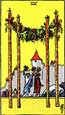
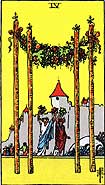 | The second card, placed above the significator, represents Air. It describes your spirit, process of thought, and the influence of reason. Four of Wands (Completion): A chance to rest and rejoice, having successfully resolved a matter of great import. The initial success of a business venture or creative project. The blossoming of a friendship or romantic relationship. Conclusions drawn based on hard won experience. Spiritual, material, or emotional rewards for diligent effort. May suggest marriage, childbirth, or a victory celebration. |
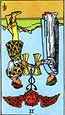
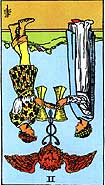 | The third card, placed to the right of the significator, represents Fire. It describes your motivations, creative energies, and the influence of passion. Two of Cups (Love), when reversed: Instability in romance, friendship, or business. A deep infatuation that excludes existing friends. A false promise or premature commitment. The entanglement of male and female interpreted in the broadest sense. The profaning of the sacred through the introduction of base desire. Folly, depletion, and waste. May suggest conflict, divorce, or a severing of ties. |
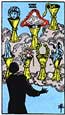
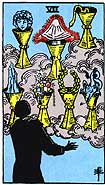 | The fourth card, placed below the significator, represents Water. It describes your emotions, meditations, and the influence of love. Seven of Cups (Temptation): Daydreams and things seen in the glass of contemplation. The scattering of energies by strong desires and unrealistic goals. The pursuit of illusions and the dissipation of energy on false choices. Intoxication, delirium, and hallucination, leading to the negation of effort. Under rare and extreme circumstances, may indicate the revelation of transcendental spiritual truth. |
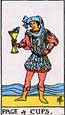
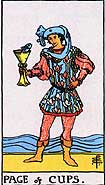 | The fifth card, placed to the left of the significator represents Earth. It describes your physical presence, position in life, and the influence of the material world. Page of Cups: The essence of water behaving as earth, such as a wellspring: An unexpected new relationship that is playful and spontaneous. A romantic soul who embraces compassion and imagination with childlike joy. Gentle reflections on love, spirituality, and the importance of personal relationships in business and material affairs. May herald the birth of a child. |
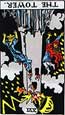
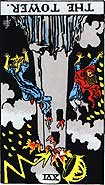 | At this point the cross is complete and the triangle is formed. The sixth card, placed on the bottom left of the triangle represents one of two opposing forces. The Tower, when reversed: Unexpected upheaval leading to a positive change in life. Catastrophe survived or narrowly avoided. A new lifestyle and enlightenment. May indicate a broken relationship, divorce, or failure in business or career. |
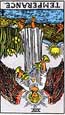
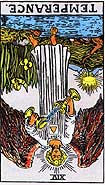 | The seventh card, placed on the bottom right of the triangle represents the force that opposes the bottom left card. These forces may be external, but they are frequently one's own inner archetypes in conflict. Temperance, when reversed: Lack of restraint and self-control. Losing one's cool. Energies dispersed through conflicts in personal, business, and spiritual matters. |
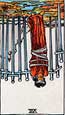
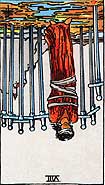 | The eighth card, the reconciler, is placed below the cross in the third vertex of the triangle. This is the force that will resolve the conflict between the bottom left and bottom right cards. By meditating on this force and bringing more of it into your life, you can bring the matter at hand to a swifter conclusion than would naturally occur. Eight of Swords (Interference), when reversed: Learning a valuable lesson from the unexpected consequences of prior decisions. Narrowly escaping criticism, censure, and the imposition of external restrictions. Focusing on the crux of a problem and freeing oneself from a difficult situation. Coming to grips with a past failure or humiliation and moving on. |
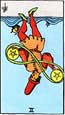
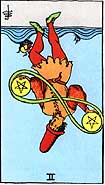 | The ninth and final card, placed in the center bottom of the triangle, represents the final outcome unless you change course. Two of Pentacles (Change), when reversed: Imbalance and disharmony as a result of upheaval and transformation. Taking one step forward for every two steps back. Chaos caused by the shifting importance of projects and priorities. Industrious yet unreliable actions. Furious activity producing negligible results. |
|
|