Today's Tarot for Nellie McKay
| The Fourfold Vision spread offers a progression of different ways of looking at an object, person, or situation. It is a powerful tool for gaining deeper insight into the specific subjects of other readings. The Rider Waite Tarot is the most widely recognized Tarot deck, and the first deck published in the 20th century. It was created by members of the Hermetic Order of the Golden Dawn, and is especially suited to questions of a mystical nature. If you would like your own copy of the Rider Waite Tarot, you can buy it now! |
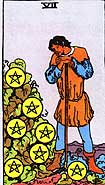 | The card on the far right represents the object being viewed, be it an idea, relationship, or the self. Seven of Pentacles (Assessment): A pause to check on the progress of your labors. Making difficult financial decisions. Exercising patience and perseverance. Evaluating the status of your work and your options for the future. |
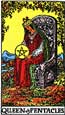
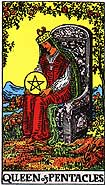 | The card second from the right represents the physical vision: how the object is seen at a base or mechanical level. Queen of Pentacles: The essence of earth behaving as water, such as a hot spring: A warm and generous host, providing shelter and comfort for all who would seek it. A person steadfast, practical, and domestic, able to create opulence and stability in any setting. The qualities of maturity and sensibility, coupled with an innate appreciation for nature and the material world. |
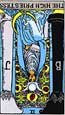
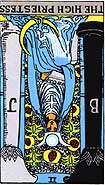 | The card in the middle represents the mental vision: the object personified and seen through a humanized perspective. The High Priestess, when reversed: Being confused and led astray from the true path. Spiritual deception. Overzealous and shallow-minded pursuit of the esoteric. Insecurity, conceit and self-destructiveness. The forces of nature unleashed. |
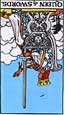
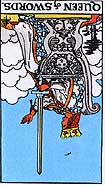 | The card second from the left represents the emotional vision: how passions and values are creatively stimulated by the mental vision. Queen of Swords, when reversed: The dark essence of air behaving as water, such as a cold rain: A person gifted with both keen logic and natural intuition, giving them uncanny powers of perception and insight. One who easily sees the weakness in any argument, and savages friend and foe alike with biting sarcasm. Dry and vicious wit covering a hollow sense of isolation and dissatisfaction with life. |
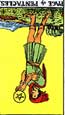
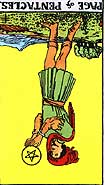 | The card on the far left represents the fourfold or mystical vision: still viewing through the previous three, we now add a spiritual element, revealing unseen aspects of the object. Page of Pentacles, when reversed: The dark essence of earth, such as a chasm: Unfavorable news about business, finance, or the physical world. One who delights in all forms of luxury and physical excess, leaving practical matters unattended. Irrationality and failure to recognize obvious facts, coupled with a poor work ethic. Wastefulness, lack of focus, and loss. May portend the loss of a job or promotion. |
|
|