Today's Tarot for Oscar Wilde
| The Fourfold Vision spread offers a progression of different ways of looking at an object, person, or situation. It is a powerful tool for gaining deeper insight into the specific subjects of other readings. The William Blake Tarot explores the mystical vision and artistry of the renowned English painter and poet. Through rich interpretations focused on creative undertakings, it has long been the deck of choice for artists, writers, musicians, and thinkers. For more information about this deck, or to buy your own personal copy, go to www.blaketarot.com.
|
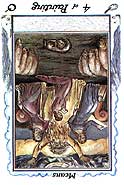 | The card on the far right represents the object being viewed, be it an idea, relationship, or the self. Four of Painting (Means), when reversed: Obsession with material prosperity and contentment. Attachment to money and material goods. Creative achievements blocked by lack of material resources. Consolidation of personnel and materials at the expense of the objective at hand. Overwhelming need for order and structure. Emphasis on controlling, dominating, or monopolizing. In the creative process: Before reaching out for creative inspiration, prepare the groundwork: by appropriately allocating your resources and assigning creative tasks. |
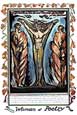
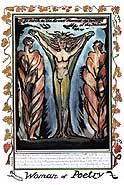 | The card second from the right represents the physical vision: how the object is seen at a base or mechanical level. Woman of Poetry: "To go forth to the Great Harvest & Vintage of the Nations". Radiating confidence, pride, and self-assurance. Being unafraid to promote yourself or reach for what you really want. Being generous and open-hearted, but also dramatic and assertive. Wanting to inspire others. Creative self-fulfillment. Gathering a rich harvest from the situation. Expressing intuitive knowledge and leadership. Mastery of expression. In the creative process: With complete confidence in your expressive abilities, you serve as a guiding light to inspire growth and confidence in others. |
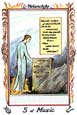
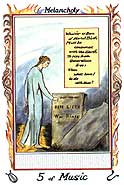 | The card in the middle represents the mental vision: the object personified and seen through a humanized perspective. Five of Music (Melancholy): "Whatever is Born of Mortal Birth / Must be consumed with the Earth / To rise from Generation free: / Then what have I to do with thee?". Emotional disappointment. Existential angst. Spiritual insights following a sad event. Separating and moving on. Sadness, loss, grieving. Acknowledging your mistakes. Releasing ties and attachments from the past. In the creative process: Convert the pain of disappointment or loss into artistic expression. Let go of something old or dead and move on to something new and alive. |
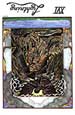
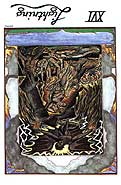 | The card second from the left represents the emotional vision: how passions and values are creatively stimulated by the mental vision. Lightning, when reversed: An unexpected shock, upheaval, or stunning event. Possibility of mental, material, or spiritual breakdown. A missed opportunity. An angry or emotional outburst. An embarrassment or blow to the ego. Broken pride. An unintended release of energy that was being conserved for another task. The house of cards collapses. Illusions are shattered. Helplessness. |
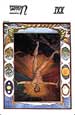
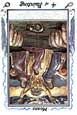
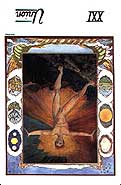 | The card on the far left represents the fourfold or mystical vision: still viewing through the previous three, we now add a spiritual element, revealing unseen aspects of the object. Union, when reversed: Something vitally important to you refuses to come together. Discord between male and female forces, or inner and outer life. Holding back. Incompleteness. Fear of intimacy or self-sacrifice. |
|
|