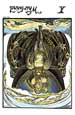
| The Celtic Cross spread is one of the most popular Tarot spreads, providing varied insight into many aspects of a complex situation and your role in it. The William Blake Tarot explores the mystical vision and artistry of the renowned English painter and poet. Through rich interpretations focused on creative undertakings, it has long been the deck of choice for artists, writers, musicians, and thinkers. For more information about this deck, or to buy your own personal copy, go to www.blaketarot.com.
|
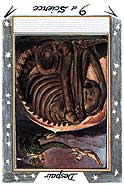 | The card not shown but at the center of the cross, represents the atmosphere surrounding the central issue. Nine of Science (Despair), when reversed: Enduring mental anguish without the need to escape reality. Support from friends in dark times. Keeping a vision of hope despite loss. A period of dark gestation. Love and forgiveness may be closer than you think. Working through guilt. Getting to the bare bones of a situation. In the creative process: Your creativity is blocked by self-judgments and criticism. Forgive yourself and get back to the basics; recapture your innocence and rejoin the human family. |
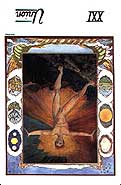 | The card visible at the center of the cross represents the obstacle that stands in your way - it may even be something that sounds good but is not actually to your benefit. Union, when reversed: Something vitally important to you refuses to come together. Discord between male and female forces, or inner and outer life. Holding back. Incompleteness. Fear of intimacy or self-sacrifice. |
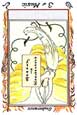
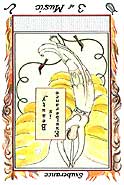 | The card at the top of the cross represents your goal, or the best you can achieve without a dramatic change of priorities. Three of Music (Exuberance), when reversed: Sense of emotional contraction. Inability to experience joy. Lack of motivation. Stagnating on the verge of new territory. An absence of enthusiasm among supportive relationships. In the creative process: Exciting and joyous progress is taking place; blow your horn! |
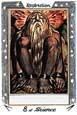
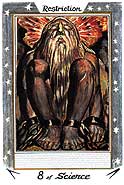 | The card at the bottom of the cross represents the foundation on which the situation is based. Eight of Science (Restriction): Being limited by mental obstacles, or by logical constraints. Feeling confined or blinded by the situation. A captive of your own ideas, anxieties, or dogmatic attitudes. Fear of failure. Repressed desires. Being in denial. Feeling frustrated or powerless. In the creative process: Make your obstructions or limitations productive by stimulating greater intensity of thought and a deeper sense of spiritual freedom. |
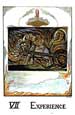
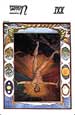
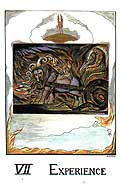 | The card at the left of the cross represents a passing influence or something to be released. Experience: Wanting to be in control of your instincts, emotions, or elemental forces. Taking the reins in the situation. Goal-oriented drive to succeed. Journeys or involvement with motion and mobility. Meeting challenges head on. |
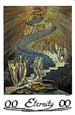
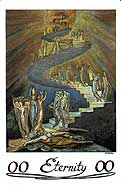 | The card at the right of the cross represents an approaching influence or something to be embraced. Eternity: The intervention of transcendent forces in the everyday world. The mighty are brought low and the meek are elevated. The transience of lesser concerns brings about the healing of old wounds and the achievement of great wisdom. A timeless perspective and the revelation of profound and immutable truth. Divine inspiration. |
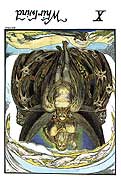 | The card at the base of the staff represents your role or attitude. Whirlwind, when reversed: Winds of change make old visions obsolete. An act of god or stroke of bad luck. Inner turmoil cleverly disguised but unrestrained. Getting the run-around. Reaching a turning point. A good time to honor your gods. |
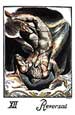
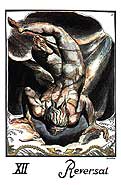 | The card second from the bottom of the staff represents your environment and the people you are interacting with. Reversal: Deliberately looking at the situation in a new way or from a different perspective. Brainstorming in a search for solutions. Turning things upside down, and being unconventional. Creative retreat into yourself. Acceptance of losses or reversals. Withstanding a difficult or uncomfortable position. |
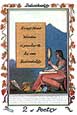
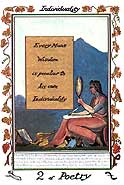 | The card second from the top of the staff represents your hopes, fears, or an unexpected element that will come into play. Two of Poetry (Individuality): "Every Mans Wisdom is peculiar to his own Individuality". Making choices based on personal perception. Evaluating the appearances of things. Exploring alternative ways of looking at a situation. Looking beyond ego-concerns to spiritual ones. Searching for self-knowledge. Deciding between societal and individual points of view. In the creative process: Distinguish between the expression of your Self and the expression of your ego; discover the difference between wise individuality and unwise individualism. |
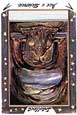
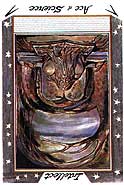 | The card at the top of the staff represents the ultimate outcome should you continue on this course. Ace of Science (Intellect), when reversed: Plunging into the depths of knowledge, at the expense of life itself. Idle pursuit of more projects than you can handle. Dabbling in many skills without every truly learning them. The worship of ideas over implementation. Workaholism, particularly in the mental sphere. Self-centered point of view. Mistaking knowledge for truth. Reliance on logic, method, and research to solve problems that demand distance and insight. In the creative process: A time for "blind" absorption of data, for intense focus on research and documentation of the creative project being initiated. |