| The Relationship spread provides insight into the interaction between two people or entities. It is the spread of choice for questions about partnerships, be they in romance or business. The Renaissance Tarot is a modern deck, with symbolism drawn from the heroic age and rendered in renaissance style. This deck is an excellent choice for exploring questions of passion, mastery, and the inner workings of human reason. If you would like your own copy of the Renaissance Tarot, you can buy it now! |
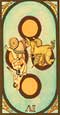
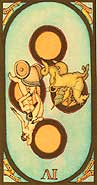 | The card at the top left represents how you see yourself. Four of Coins (Power), when reversed: Equanimity. Suspension of conflict. Balance of power. |
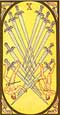
 | The card at the top right represents how you see your partner. Ten of Swords (Ruin), when reversed: Fame or glory blooming forth from misfortune. Cruel reality ennobled by art. |
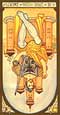
 | The card in the center left represents how you feel about your partner. Queen of Swords, when reversed: Consuming fire; the flames of the martyrdom of Joan of Arc, Phaedra's misguided passion, Medea's jealousy, Lady Macbeth's ambition. Fire, if left to burn unchecked, can consume the soul. |
 | The card in the center right represents what stands between you and your partner. Ace of Swords: In the realm of events, the card signifies triumphant power. Whether for good or ill. For the life of the mind it represents the active, passionate impulses. It declares the dominance of the will and zealous, even fanatical, political or religious convictions. It is the sword of righteousness. |
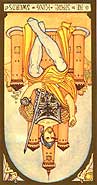 | The card in the lower left represents how your partner sees you. King of Swords, when reversed: Abuse of power. Tyranny. Cruelty. The empty striving for control. A failed attempt at mastery. |
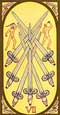
 | The card in the lower right represents what your partner feels about you. Seven of Swords (Futility): Favorable turn of events. Hope for sustained success. Vigilance and strength. |
 | The card in the center represents the present status or challenge of the relationship. Eight of Cups (Indolence): A moment of surrender to external forces. Capitulation to inner promptings. Giving in to temptation. Giving oneself over to oblivion, to intoxication, to sleep. |