Today's Tarot for Jerry Seinfeld
| The Cross and Triangle spread is a powerful means of understanding complex situations, developed by the Hermetic Order of the Golden Dawn. This spread is rich in occult and mystical symbolism, and one of our favorites here at Facade. The William Blake Tarot explores the mystical vision and artistry of the renowned English painter and poet. Through rich interpretations focused on creative undertakings, it has long been the deck of choice for artists, writers, musicians, and thinkers. For more information about this deck, or to buy your own personal copy, go to www.blaketarot.com.
|
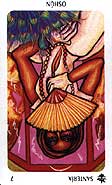
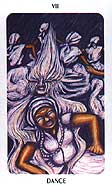
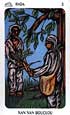
 | The first card, the significator, is placed in the center of the cross. This card represents the prime energy manifest in your life. Angel of Music: "Like as an angel glitt'ring in the sky, / In times of innocence and holy joy: / The joyful shepherd stops his grateful song. / To hear the music of an angel's tongue". A surge of passionate emotion. A call for compassion in the situation. A need to rise above a mundane or materialistic milieu. Possibility of being granted a favor or indulgence. An unexpected emotional influence. Emerging impulse to personal transformation. Development of appropriate aesthetic sensibility. Intuitive awareness of public needs or the mass media. In the creative process: An inrush of excitement or appearance of a new factor offers alternative possibilities for your work. |
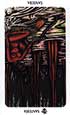
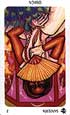
 | The second card, placed above the significator, represents Air. It describes your spirit, process of thought, and the influence of reason. Five of Painting (Hardship), when reversed: Transcending difficulties, insecurity, and financial worries. Taking responsibility for ones own actions or mistakes. Stripping down for action. Facing up to your fears and critics. Issues of support, loyalty, or companionship in hard times. In the creative process: Realize that the problems you are trying to solve may put you at odds with others who do not recognize your value. Be ready to grapple with personal blocks and fears, and to hear more from your inner voice than reasons why things won't work. |
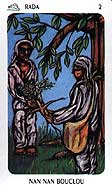
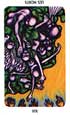
 | The third card, placed to the right of the significator, represents Fire. It describes your motivations, creative energies, and the influence of passion. Two of Painting (Balance): A choice regarding something tangible or physical. Body-awareness is a key factor; hang in there. Balance as a dynamic force. Using interaction and negotiation to keep energy flowing. Stretching your abilities to bridge a gap or to reconcile differences. In the creative process: A breach in the project requires inner strength and timely decisions; stick with the task and seek cooperative assistance. |
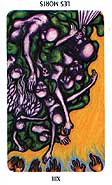
 | The fourth card, placed below the significator, represents Water. It describes your emotions, meditations, and the influence of love. Seven of Science (Lamentation): Psychic energy restrained. Feeling burdened with heavy thoughts. Pushing yourself too hard. Wallowing over and refusing to accept the situation. Straining against something. In the creative process: When you are feeling stuck or blocked, push your imagination to find a way around the problem; rely on your energy and hard work. |
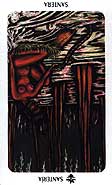
 | The fifth card, placed to the left of the significator represents Earth. It describes your physical presence, position in life, and the influence of the material world. Five of Poetry (Strife): "Thou art a Man / God is no more / Thy own humanity / learn to adore For that is my / Spirit of Life / Awake arise to Spiritual Strife". A need for self-improvement. Struggling with inner demons, such as issues of conscience. Falling into disillusionment, or the dark side of the matter. Competition, arguments, power struggles. Getting "thrown for a loop." In the creative process: This points to a stressful time battling inner doubts and outer difficulties; you can improve your project or product by getting to the truth of the matter. |
 | At this point the cross is complete and the triangle is formed. The sixth card, placed on the bottom left of the triangle represents one of two opposing forces. Three of Painting (Practice), when reversed: Failure to master your skills and talents. Lack of engagement with your peers. Unwillingness to synthesize the available factors. Failure to build support. In the creative process: Experimentation and manipulation are the keys to acquiring the experience needed to get the job done. |
 | The seventh card, placed on the bottom right of the triangle represents the force that opposes the bottom left card. These forces may be external, but they are frequently one's own inner archetypes in conflict. Child of Painting: Riding the wave of prosperity. A time to show your hand and reveal your innate powers. Enjoying a position of material advantage. Putting forth charisma. Hedonistic enjoyment. Drug experimentation. Surfing the Internet. Total absorption in your activities. Trusting your body and instincts. Open to new experiences. In the creative process: Now is a time to experiment with processes and materials, taking great pleasure in what you learn and create. |
 | The eighth card, the reconciler, is placed below the cross in the third vertex of the triangle. This is the force that will resolve the conflict between the bottom left and bottom right cards. By meditating on this force and bringing more of it into your life, you can bring the matter at hand to a swifter conclusion than would naturally occur. Man of Science: Being submerged in thought. A time of intense mental focus. Perfectionism. Personal detachment and self-possession. Working on your own, or in isolation. In the creative process: Scrutinize and test every aspect of your work so as to refine and perfect it. |
 | The ninth and final card, placed in the center bottom of the triangle, represents the final outcome unless you change course. Eight of Music (Discontent): "Clouded with discontent & brooding in their minds terrible things". Disappointment or dissatisfaction. Troubled emotions below the surface. Feeling at the mercy of circumstances. Possibility of emotional breakdown. Fears of what may happen. Apprehensions about the unknown. Paranoia. Feelings of missing out on something. Former values and friends no longer interest you. Wanting to escape the situation. In the creative process: Psychodrama and emotional torments can serve as imaginative stimulants. Expressing and documenting what you feel can be artful as well as healing. |
|
|