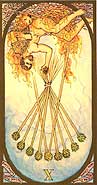
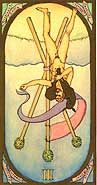
| The Celtic Cross spread is one of the most popular Tarot spreads, providing varied insight into many aspects of a complex situation and your role in it. The Renaissance Tarot is a modern deck, with symbolism drawn from the heroic age and rendered in renaissance style. This deck is an excellent choice for exploring questions of passion, mastery, and the inner workings of human reason. If you would like your own copy of the Renaissance Tarot, you can buy it now! |
 | The card not shown but at the center of the cross, represents the atmosphere surrounding the central issue. King of Staves: A renaissance man, practical and imaginative, active and contemplative, forceful and chivalrous. Appreciation of the lessons and pleasures of life. Worldliness in the best sense. An intellectual, an artist or an inventor. |
 | The card visible at the center of the cross represents the obstacle that stands in your way - it may even be something that sounds good but is not actually to your benefit. King of Coins, when reversed: If intelligent, one susceptible to the influence of the child of Saturn, Accidia, the inertia and melancholy of the philosophers. If conventional, then an avarice and greedy person preoccupied with money, with an idolatrous faith in the exploitation of the earth and a distrust of nature. |
 | The card at the top of the cross represents your goal, or the best you can achieve without a dramatic change of priorities. The Devil, when reversed: Irresponsible pleasures. Prankishness. Childish panic. Undignified behavior. Fare baccano, to "paint the town." |
 | The card at the bottom of the cross represents the foundation on which the situation is based. Ace of Swords: In the realm of events, the card signifies triumphant power. Whether for good or ill. For the life of the mind it represents the active, passionate impulses. It declares the dominance of the will and zealous, even fanatical, political or religious convictions. It is the sword of righteousness. |
 | The card at the left of the cross represents a passing influence or something to be released. The Hierophant: The abstract, spiritual and intellectual side of the animus, or masculine nature of the soul. Spiritual authority. Religious tradition. Avuncular wisdom. The old order and the old school. |
 | The card at the right of the cross represents an approaching influence or something to be embraced. Page of Coins, when reversed: An unrealistic deluded state of mind. Rationalizations. Pseudoscience. |
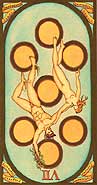
 | The card at the base of the staff represents your role or attitude. Ten of Coins (Wealth): Prosperity. Tranquility. Family affection. |
 | The card second from the bottom of the staff represents your environment and the people you are interacting with. The Emperor, when reversed: Tyranny. Pomposity. Jove-like self-indulgence. |
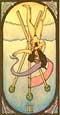
 | The card second from the top of the staff represents your hopes, fears, or an unexpected element that will come into play. Four of Staves (Completion), when reversed: Preoccupations. Discord in relationships. |
 | The card at the top of the staff represents the ultimate outcome should you continue on this course. Seven of Swords (Futility), when reversed: Uncertainty. Disagreements. |