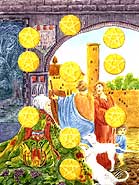
| The Celtic Cross spread is one of the most popular Tarot spreads, providing varied insight into many aspects of a complex situation and your role in it. The Renaissance Tarot is a modern deck, with symbolism drawn from the heroic age and rendered in renaissance style. This deck is an excellent choice for exploring questions of passion, mastery, and the inner workings of human reason. If you would like your own copy of the Renaissance Tarot, you can buy it now! |
 | The card not shown but at the center of the cross, represents the atmosphere surrounding the central issue. Eight of Swords (Interference): Emotional disaster. Loss of a beloved person or a valued situation. A sadness that creates a new strength and resolve. |
 | The card visible at the center of the cross represents the obstacle that stands in your way - it may even be something that sounds good but is not actually to your benefit. Two of Cups (Love), when reversed: Separation. Dissolution. Unhappy love. |
 | The card at the top of the cross represents your goal, or the best you can achieve without a dramatic change of priorities. Six of Cups (Pleasure): Regret and nostalgia for a time past or a love lost. Disillusionment. |
 | The card at the bottom of the cross represents the foundation on which the situation is based. King of Cups: A dignified and accomplished person, compassionate and intuitively accurate. A successful professional, humanitarian and idealistic. One who appreciates the Dionysian side of the arts and the wild, mysterious aspect of nature. |
 | The card at the left of the cross represents a passing influence or something to be released. Seven of Swords (Futility), when reversed: Uncertainty. Disagreements. |
 | The card at the right of the cross represents an approaching influence or something to be embraced. Nine of Staves (Strength): Attempted betrayal in the guise of aid. Hidden enemies, risk and conflict. |
 | The card at the base of the staff represents your role or attitude. Five of Coins (Worry), when reversed: Reversal of a difficult situation. Gradual improvement. Encouraging news. |
 | The card second from the bottom of the staff represents your environment and the people you are interacting with. Four of Swords (Truce): Retreat from the battlefield of life. A rest from the conflicts with colleagues or competitors. Calm in the storm. Self-imposed exile. |
 | The card second from the top of the staff represents your hopes, fears, or an unexpected element that will come into play. Four of Coins (Power), when reversed: Equanimity. Suspension of conflict. Balance of power. |
 | The card at the top of the staff represents the ultimate outcome should you continue on this course. The Hierophant, when reversed: Dogmatic beliefs. Spiritual authoritarianism. Enfeebled philosophizing. |